Posts

Showing posts from April, 2012

Stop Slipping Kumihimo Cords: How to Fix Weak Downward Tension

Image
You are right in the zone, moving your strands with perfect focus, when suddenly— snap . A cord slips entirely out of its foam slot. You pop it back in, make two more moves, and another one slides loose. Before you know it, you are fighting your Kumihimo disk just to keep your threads from unraveling. Slipping cords are incredibly frustrating, but they are actually a symptom of a very specific mechanic: inadequate downward weight . When your center pull isn't strong enough to lock the core of the braid in place, the strands lose their anchor point, causing them to dance around and slip right past the foam grips. Let’s look at exactly how to fix your downward pull and secure your strands for good. The Fast Fix for Slipping Cords (Featured Snippet Target): If Kumihimo cords keep slipping out of their slots, it means there isn’t enough downward weight pulling the braid core through the center hole to anchor the strands. To fix this instantly...

Beaded Kumihimo

Image
Kumihimo beading An old type of Japanese braiding, kumihimo was really created to the seal regarding battle suits for Japanese samurai and the horses. Afterwards, kumihimo braids had been utilized to secure quilted coats as well as kimonos. Nowadays, kumihimo is much more well-known than in the past and also beaders have discovered exactly how these types of braids may be used to highlight a unique lampwork cyrstal glass bead and just how they may be adorned together with strands associated with gleaming gemstone beads. Kumihimo is completed over a light in weight disk, usually done of froth, along with steps for every follicle associated with dietary fiber becoming braided. Another kind of free-standing kumihimo device is known as the marudai as well as is made up of wooden group upon 4 hip and legs. Materials attached with bobbins tend to be braided with the pit down the middle of the actual wooden group. The simple, stroking movements associated with braiding materials with each ...

Kumihimo Instruction - Braiding Disk Template

Image
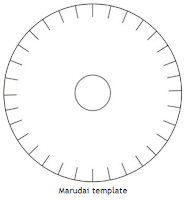
"Kumi" means to braid or gather together and "Himo" means string or cord so "Kumihimo" means simply braided cords. Traditionally Kumihimo is done on a Marudai which is a round wooden stand that the braider would kneel at. Modern braiders tend to braid at tables and Marudai can be made of plastic and more portable versions are simple disks cut from thick foam rubber. For a simple eight-strand braid you will need: A sheet of thick card 2 strands of thread or yarn a meter long in one colour 2 strands of thread or yarn a meter long in another colour Scissors Instructions First make your Marudai, use the template below to cut one from your card. Fold your 4 strands in half and knot them to make a loop, push this through the hole in the centre of your Marudai and wedge the strands into the slits as shown Move the top right strand to the slit to the right of the bottom pair then the bottom left strand to the slit to the left of the top strand. Rota...