Posts

Showing posts with the label flat braid kumihimo patterns

Stop Slipping Kumihimo Cords: How to Fix Weak Downward Tension

Image
You are right in the zone, moving your strands with perfect focus, when suddenly— snap . A cord slips entirely out of its foam slot. You pop it back in, make two more moves, and another one slides loose. Before you know it, you are fighting your Kumihimo disk just to keep your threads from unraveling. Slipping cords are incredibly frustrating, but they are actually a symptom of a very specific mechanic: inadequate downward weight . When your center pull isn't strong enough to lock the core of the braid in place, the strands lose their anchor point, causing them to dance around and slip right past the foam grips. Let’s look at exactly how to fix your downward pull and secure your strands for good. The Fast Fix for Slipping Cords (Featured Snippet Target): If Kumihimo cords keep slipping out of their slots, it means there isn’t enough downward weight pulling the braid core through the center hole to anchor the strands. To fix this instantly...

Kumihimo Friendship Bracelets

Image
Kumihimo Series - A fashionable version of the friendship bracelets you dress in as a kid. Necklace and bracelets are made of a braided cord using the Japanese method of Kumihimo.* Beads are then hand-stitched on the braid. They are complete with a hook and a charm on the end to give them an adult feel. Wear bracelets set on your wrist just like you did when you were young! All pieces are one of a kind owed to the nature of their design. * Kumihimo : The best projecting historical use of the cords by samurai as both a useful and attractive way to lace their lamellar armor and their horses’ armor (barding). Kumihimo cords are now used as ties on haori coats and obijimes, which are used for tying on an obi (kimono sash).

Kumihimo Instruction - Braiding Disk Template

Image
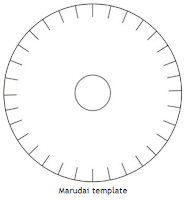
"Kumi" means to braid or gather together and "Himo" means string or cord so "Kumihimo" means simply braided cords. Traditionally Kumihimo is done on a Marudai which is a round wooden stand that the braider would kneel at. Modern braiders tend to braid at tables and Marudai can be made of plastic and more portable versions are simple disks cut from thick foam rubber. For a simple eight-strand braid you will need: A sheet of thick card 2 strands of thread or yarn a meter long in one colour 2 strands of thread or yarn a meter long in another colour Scissors Instructions First make your Marudai, use the template below to cut one from your card. Fold your 4 strands in half and knot them to make a loop, push this through the hole in the centre of your Marudai and wedge the strands into the slits as shown Move the top right strand to the slit to the right of the bottom pair then the bottom left strand to the slit to the left of the top strand. Rota...