Posts

Stop Slipping Kumihimo Cords: How to Fix Weak Downward Tension

Image
You are right in the zone, moving your strands with perfect focus, when suddenly— snap . A cord slips entirely out of its foam slot. You pop it back in, make two more moves, and another one slides loose. Before you know it, you are fighting your Kumihimo disk just to keep your threads from unraveling. Slipping cords are incredibly frustrating, but they are actually a symptom of a very specific mechanic: inadequate downward weight . When your center pull isn't strong enough to lock the core of the braid in place, the strands lose their anchor point, causing them to dance around and slip right past the foam grips. Let’s look at exactly how to fix your downward pull and secure your strands for good. The Fast Fix for Slipping Cords (Featured Snippet Target): If Kumihimo cords keep slipping out of their slots, it means there isn’t enough downward weight pulling the braid core through the center hole to anchor the strands. To fix this instantly...

Share Your Kumihimo Patterns Here

Please share your kumihimo designs and kumihimo instructions in the comment section.

Beaded Kumihimo

Image
Kumihimo beading An old type of Japanese braiding, kumihimo was really created to the seal regarding battle suits for Japanese samurai and the horses. Afterwards, kumihimo braids had been utilized to secure quilted coats as well as kimonos. Nowadays, kumihimo is much more well-known than in the past and also beaders have discovered exactly how these types of braids may be used to highlight a unique lampwork cyrstal glass bead and just how they may be adorned together with strands associated with gleaming gemstone beads. Kumihimo is completed over a light in weight disk, usually done of froth, along with steps for every follicle associated with dietary fiber becoming braided. Another kind of free-standing kumihimo device is known as the marudai as well as is made up of wooden group upon 4 hip and legs. Materials attached with bobbins tend to be braided with the pit down the middle of the actual wooden group. The simple, stroking movements associated with braiding materials with each ...

Kumihimo Instruction - Braiding Disk Template

Image
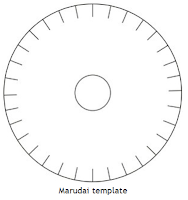
"Kumi" means to braid or gather together and "Himo" means string or cord so "Kumihimo" means simply braided cords. Traditionally Kumihimo is done on a Marudai which is a round wooden stand that the braider would kneel at. Modern braiders tend to braid at tables and Marudai can be made of plastic and more portable versions are simple disks cut from thick foam rubber. For a simple eight-strand braid you will need: A sheet of thick card 2 strands of thread or yarn a meter long in one colour 2 strands of thread or yarn a meter long in another colour Scissors Instructions First make your Marudai, use the template below to cut one from your card. Fold your 4 strands in half and knot them to make a loop, push this through the hole in the centre of your Marudai and wedge the strands into the slits as shown Move the top right strand to the slit to the right of the bottom pair then the bottom left strand to the slit to the left of the top strand. Rota...

Kumihimo Braids - Seven Strand Braid

Image
This is a great introductory braid. You can make your own disk by cutting a circle out of cardboard or craft foam. For this braid, you will need 8 slits cut around the edge of the disk (evenly spaced) and seven strands of yarn cut to your desired length. Also cut a hole in the center of the disk (shaded area shown at right.) For fun, experiment with using different color & texture yarns. Tie an overhand knot in one end of the strands and place it through the hole in the center of the disk. NOTE: If you want to make a bracelet, use three long strands folded in half plus one strand (half the length of the others) to make your seven strands. Fold them in half before tying the overhand knot so that it forms a loop that can be used as a clasp. Place one strand in each of the slits (1-7), leaving slit 8 open. Hold the card with the empty slit towards you. (You don’t need to keep track of the slit numbers, I just wrote them here to help with the initial set-up.) From the empty sl...

Constructing Kumihimo Tama for Kumihimo Braiding

Image
Materials needed for eight tama: (The wood parts for these bobbins are manufactured by Lara’s Crafts and can be purchased at most craft stores. The weights can be found in most fishing supply stores) �� 8 Wood Spools 7/8” x 1-1/8” (part # U10018, 3 per pkg) �� 16 Wood Circles 3/4” (part # U10817, 6 per pkg) �� 16 Bullet Weights 1/8 oz.(part # BW18, 12 per pkg) �� White Glue Assembly instructions: Step 1: Cover one side of 1 wooden circle with white glue Press it firmly onto one end of one of the spools. Make sure that it is centered and even. Wipe off any excess glue. Repeat for the rest of your bobbins and set them aside to dry for a few hours. Step 2: Turn one bobbin open end up and drip four or five drops of white glue into the hole. Drop in one weight (point down) into the hole. Add two or three more drops of glue. Drop in the last weight (wide end down) and finish with several more drops of glue. Finally, secure a wooden circle over the hole as you did in Step 1. Repe...

Kumihimo Patterns for the Kongo Gumi Braid

Image
Kumihimo is the ancient Japanese art of braiding cord (“kumi”= to braid, “himo” = cord). Over the centuries, these cords have been used for religious ceremonies, lacing samurai armor, securing the kimono sash (obi) and other decorative uses. There are hundreds of braiding structures, ranging from simple to very complex, and requiring from 4 to over 100 threads. The braid described here is traditionally made on a round braiding stand (marudai) which uses weighted bobbins to produce a balanced tension and manage long threads. However, some of the more simple braids such as this one can also be done as short samples using a portable diskshaped card, which you can make yourself out of cardboard or craft foam, or purchase in kit form. These instructions are for one of the simplest braiding structures called kongo gumi (= hard braid), which produces a solid cord with a round crosssection (as opposed to a shoe lacestyle hollow cord or a flat braid). The braiding movements can be made with 8...

Kumihimo Pictures - 8 Thread Kongo Gumi Patterns (Part 1)

Image
Kumihimo Patterns - 8 Thread Kongo Gumi Patterns (Part 1)